CURRENT & PAST PROJECTS
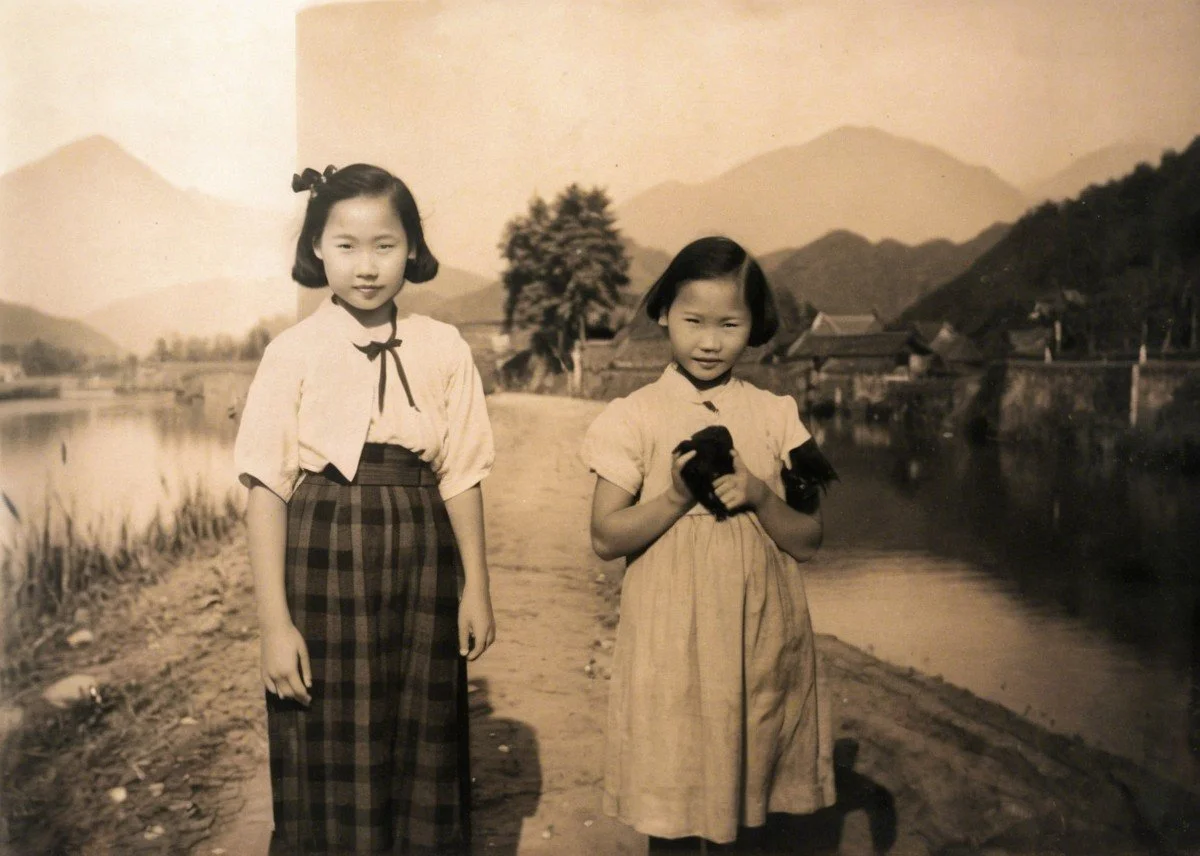
Re-imagining Family - Janet Chan and Zorica Purlija
Immigrants often lose family members through wars, illnesses or migration. In this exhibition we present the process and outcomes of our collaboration in re-imagining portraits of family members who had passed away leaving no visual records. By using images of close relatives, we tried to recreate, using AI software and prompts, possible images of lost family members. The experience of using AI to re-create images of lost family members will be documented as part of the exhibition.
In creating these images, we are of course working in the realm of speculation. As Rubinstein and Fisher (2013:8) suggest: “It now seems that it is the humble photographic image … that encapsulates the interlacing of physical and algorithmic attributes, aesthetic and political forms, which characterise the age of information capitalism. It seems that the digital-born image has become a hinge between these physical and digital modes of existence, combining as it does elements of familiar ocularcentric culture – with its trust and reliance on the true-to-life photograph – and algorithmic processes that problematise the presumption of an ontological connection between images and objects.”
This is a first collaboration between Janet Chan and Zorica Purlija.
Both artists are aware of the dangers of using AI for predictive purposes, but seeing these imagined images of loved ones provided some degree of comfort from the grief of not having pictures of them. As Pillay (2025) suggests, “There may be real therapeutic and emotional value in being able to reconnect and potentially achieve closure with lost loved ones” even though there is a risk that we may be “left vulnerable to life’s unexpected challenges” if we relied on such “digital reincarnates”.
References:
Rubinstein, Daniel and Andy Fisher (2013) Introduction. In Rubinstein et al. (eds. 2013)On the Verge of Photography. ARTicle Press, Birmingham.
Pillay, Tharin (2025) ‘The Dead Have Never Been This Talkative’: The Rise of AI Resurrection. Time. 28 June 2025.

Faces of Intelligence: Playing with AI
This body of work explores the limits and potential of AI art through a series of experiments in visual and textual creativity using AI generative software*.
The focus of the research is on facial recognition systems, the application of which has been controversial. Among issues of concern is the accuracy of such systems for recognising faces of non-white people. In some sense, the work turns this debate on its head: instead of investigating the accuracy of AI systems per se, it presents the visual images created by AI software in response to prompts about racial and age categories. The generative capacity of AI is also tested in poetry created by an AI software in response to a prompt about the biases of facial recognition technology.
An exhibition of artwork and poetry generated as part of this project was shown in as Faces of Intelligence: Playing with AI on 5-21 May at the AIRspace Projects Gallery. A related piece of artwork “Unusual Suspects” has been accepted for publication in Surveillance & Society’s themed issue “AI and Surveillance”. Forthcoming 2023.

AI Redacted
AI Redacted is an experiment in erasure poetry which continues a tradition of creating of ‘found’ poetry through erasing a large portion of an existing text, in this case a 1986 technical report from New York University titled The Limits of Artificial Intelligence by Jacob T Schwartz. Erasure is a subtractive and transgressive process, but also an additive and collaborative one. The transformation of a technical report into a poetic form is both disruptive and playful, an invitation to craft new meanings from old text. Pages of the report are reimagined as a palimpsest of scientific ideas turned provocative; the text floats on top of a layer of AI-generated images, hinting at an unanticipated, if not dystopian, future.
This work draws on my research on the social impact of Artificial Intelligence (AI). As one of the latest technological tools that promise greater efficiency and effectiveness in decision-making, AI has infiltrated both public and private institutions, its reach is mostly invisible and its adverse social impact only recently acknowledged and investigated.
An exhibition of this work can be viewed at https://firstdraft.org.au/soft-power-pages/ai-redacted-janet-bi-li-chan from 26 October to 31 December 2021 as part of Firstdraft’s Soft Power project.

My (M)other(‘s) Story
I have always wanted to write about my mother’s story, but it was not until November, 2014, when I was awarded a residency at Varuna that I considered it seriously. At the time, I examined my motivation for wanting to tell the story, and tried out several openings. I did this by hand, with a fountain pen. For some reason, I kept writing “my other” rather than “my mother”. Ultimately, I settled on My Other Story.
An exhibition of artwork and poetry I have created as part of this project was shown in the exhibition Weaving Selves in June 2021 at the AIRspace Projects Gallery.

二十八万步 280,000 Steps: On the road from Robe to Ballarat
While researching the history of Chinese people in Australia, I came across an account of Chinese gold miners in the 1850s walking from Robe to the Victorian goldfields to avoid the tax imposed by the Victorian government on Chinese immigrants. The idea of walking 400 km from Robe to Ballarat was starting to form, even though I had never done any kind of long distance walking in my life. In the end, I decided to walk the first and last 100 km of this journey.
An exhibition of the artwork and poetry I made in response to the walk was shown in July 2020 at the AIRspace Project gallery. Three poems from this collection have been published in an anthology On the Road by The Poet magazine (2020).

Mapping Crises–Visualising Hope
This work was developed while I was artist-in-residence at the SEA Foundation, Tilburg in October 2017. The lecture-performance reflects on the international refugee crisis through data visualisation and explores their human dimensions through sounds, drawings, poetry and spoken words. This video shows the slides, images and spoken words from the lecture performance on 27 October 2017. Some copyrighted works were omitted.

My Data My Self
This work arose from my academic research on big data and my art practice on surveillance. It seeks to generate an innovative way of representing the mixed impact of big data on the consciousness and identity of citizens, who are faced with the dilemma of dealing with anxieties about state surveillance and the seductions of social networking. This was shown in a Group Exhibition The Cloud in Rapids: Transformation from knowledge to bits, 19 May to 19 June 2017, SEA Foundation, Tilburg, The Netherlands, and also at an academic conference Metric Culture: The quantified self and beyond on 7-9 June 2017 at Aarhus, Denmark.

Mounting Evidence: Traces of things to come
Drawing on popular culture’s fascination with forensic science, these paintings play with physical evidence and literally generates mountains out of molehills. In manipulating proofs of where things have been, I create a fantasy of how things can become when taken out of context. Focusing on the legal system as a symbol of the superiority of Western civilisation, the project explores the ‘majesty’ of justice as it is manifested in the everyday administration of criminal cases, where the prosecution builds its argument out of the fragments of evidence collected, analysed and presented as a coherent story of actions and intentions.